
Dubai Buying Guide
48V vs 72V Electric Golf Carts in Dubai: Which Is Right for You?
Compare performance, passenger load, range, charging and real-world use before choosing the voltage for your villa, resort, community or commercial fleet.
Author: SUN CART Editorial Team Publisher: SUN CART Date Published: 2026-09-22 Date Modified: 2026-09-22
Voltage is one of the first specifications buyers notice when comparing electric golf carts. It is also one of the easiest specifications to misunderstand. A 72V badge does not automatically guarantee a faster cart, a longer driving range or a better ownership experience. The result depends on the complete system: battery capacity, motor, controller, gearing, vehicle weight, passenger load, tyres and software settings.
For buyers in Dubai, the correct choice should begin with the actual route and operating schedule. A cart used for relaxed trips around a villa has different requirements from a six-seat resort shuttle that moves guests throughout the day.
Quick answer
Choose a well-matched 48V configuration for normal short-distance use, moderate passenger loads and straightforward routes. Consider a properly engineered 72V configuration when the cart must handle heavier loads, stronger acceleration requirements, longer duty cycles or more demanding terrain. Compare complete vehicle specifications—not voltage alone.
What Does 48V or 72V Actually Mean?
The voltage describes the electrical potential of the battery system. It is not the same as battery capacity, which is commonly expressed in amp-hours (Ah) or kilowatt-hours (kWh). Two carts can use the same voltage and still provide very different performance or range because their battery capacity, motor and controller are different.
A simple way to understand the relationship is:
Voltage helps describe how electrical power can be delivered.
Battery capacity helps describe how much energy is available. The controller and motor determine how that energy is used.
This is why the correct question is not only “48V or 72V?” It is “Which complete powertrain is suited to my passenger load, route, speed requirement and daily operating time?”
48V vs 72V Golf Cart Comparison
| Decision factor | 48V configuration | 72V configuration |
|---|---|---|
| Typical fit | Villas, communities, golf courses and lighter daily transport | Heavier passenger use, demanding routes and longer commercial duty cycles |
| Acceleration and load | Can be smooth and capable when the motor and controller are correctly matched | Can support stronger power delivery, but only when the complete system is designed for it |
| Range | Depends on usable battery energy, load, speed, terrain and temperature | Not automatically longer; battery capacity and efficiency remain critical |
| Charging | Requires a charger designed for the exact 48V battery chemistry and pack | Requires a charger designed for the exact 72V battery chemistry and pack |
| Cost and complexity | Often the practical starting point for normal use | May involve a higher-spec battery, controller, motor and charger |
| Best buying method | Compare the exact cart under a realistic passenger load and route—not the voltage label alone. | |
When a 48V Electric Golf Cart Makes Sense
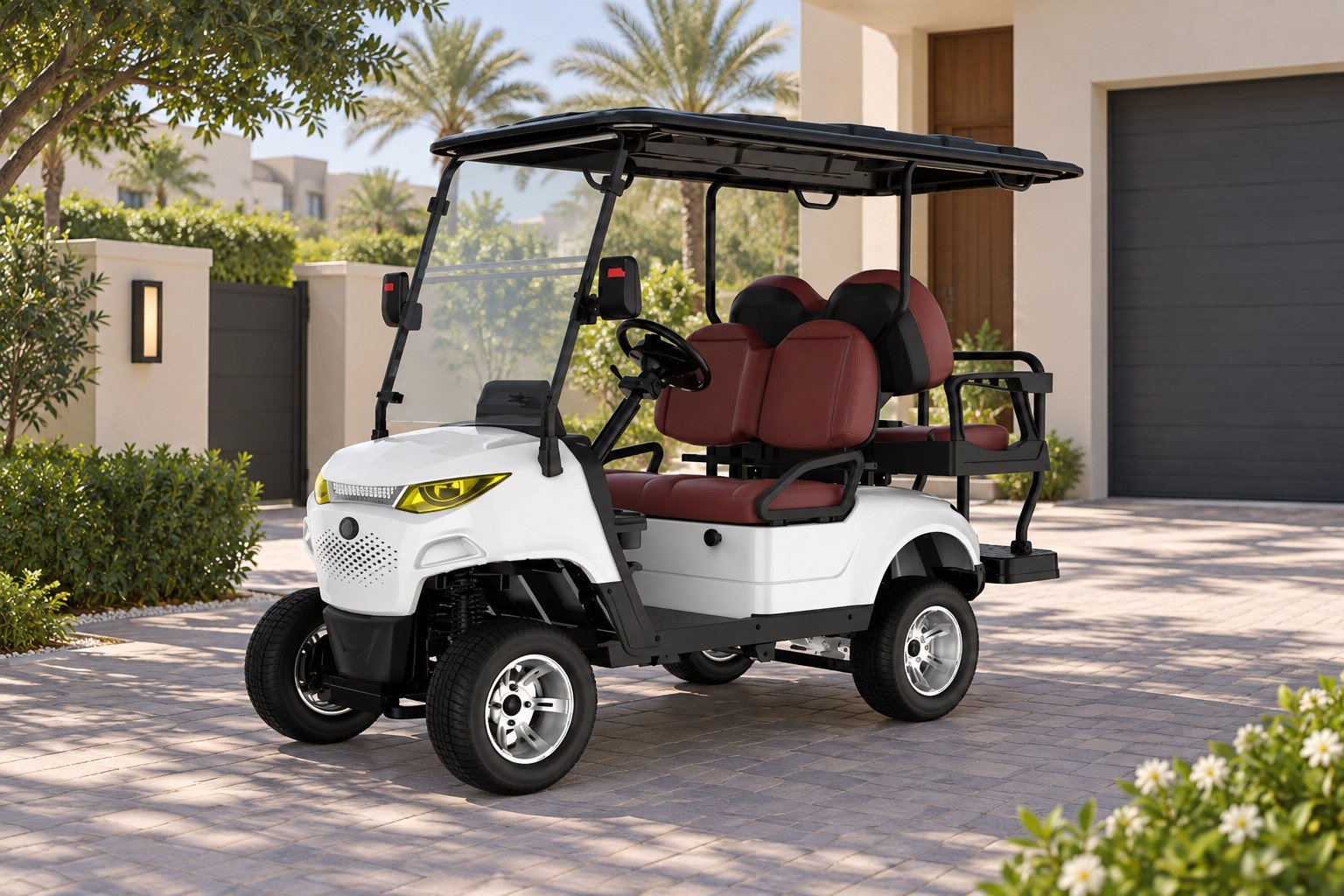
A well-designed 48V cart can be a practical choice for many Dubai buyers. It may be all you need when the route is predictable, slopes are limited and the cart is not expected to carry a full passenger load continuously.
Good use cases
- Private villas and estates
- Gated communities
- Golf course transport
- Security and maintenance rounds
- Short trips around managed properties
Check before buying
- Maximum passenger and cargo load
- Motor rating and controller setup
- Usable battery capacity
- Expected distance between charges
- Local parts and diagnostic support
Do not reject a 48V cart simply because a higher-voltage model is available. If the complete configuration meets the real operating requirement, a 48V system may offer the balance of performance, cost and serviceability you need.
When a 72V Electric Golf Cart May Be Better
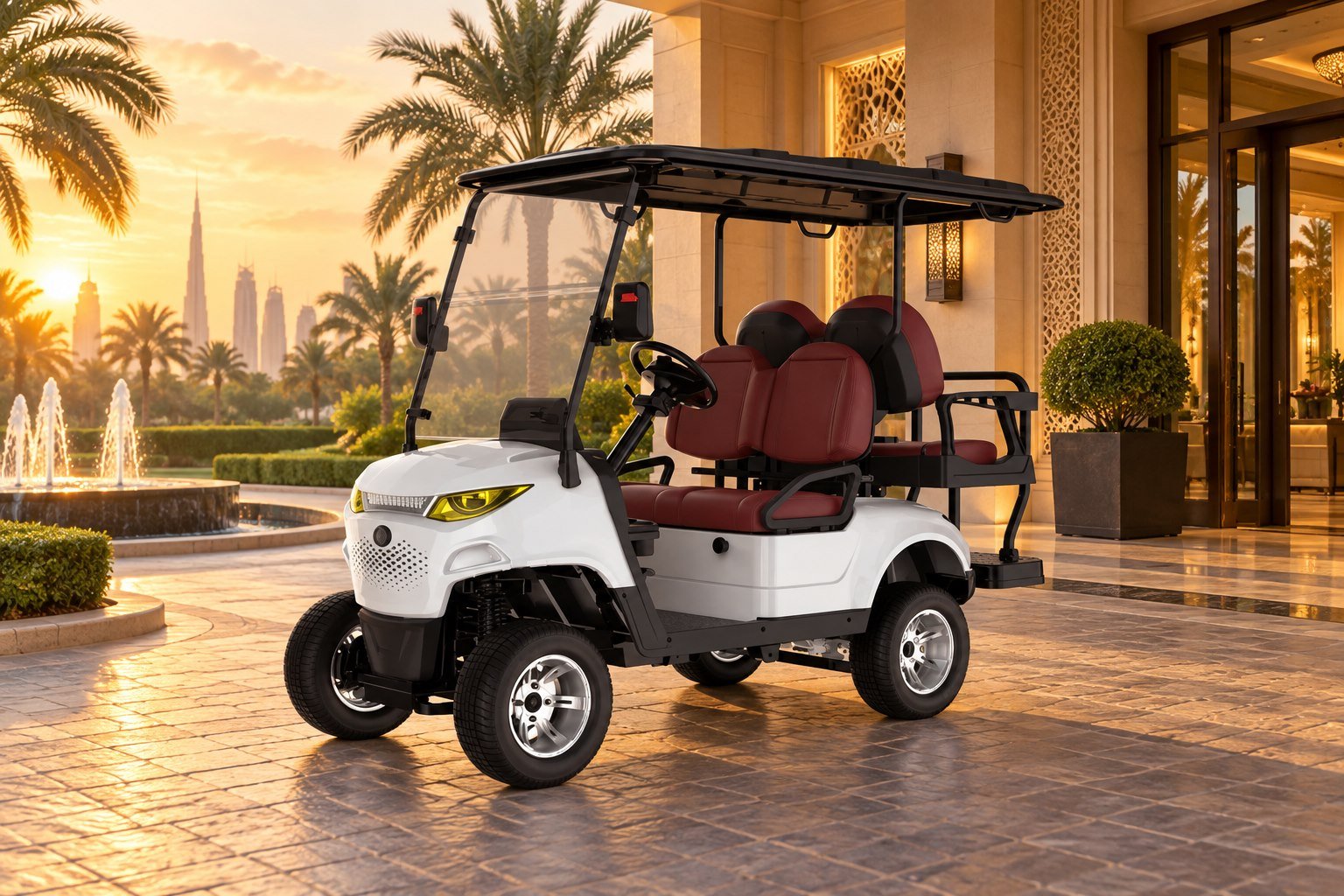
A 72V system may be worth evaluating when the vehicle must move more passengers, operate for longer periods or provide stronger performance under load. This can be relevant for hospitality, commercial and fleet applications, but the specification still needs to be verified as a complete system.
Potential use cases
- Six- or eight-seat guest transport
- Hotels and resorts with repeated trips
- Event venues and commercial properties
- Routes with heavier passenger loads
- Applications requiring stronger acceleration
What must also match
- Battery capacity and battery management system
- Motor and controller ratings
- Brakes, tyres and suspension
- Charger and charging location
- Warranty and UAE service capability
Higher voltage is useful only when the rest of the cart can safely and efficiently use it. A poorly matched 72V configuration should not be considered better than a properly engineered 48V cart.
Does 72V Mean More Range?
Not necessarily. Driving range is influenced more directly by the amount of usable battery energy and how efficiently the vehicle uses it. Passenger weight, speed, stop-start driving, tyre pressure, road surface, slopes, air temperature and accessory use can all change the distance achieved on one charge.
When comparing two models, ask the supplier for the following information:
- ✓ Battery chemistry and usable capacity
- ✓ Test conditions behind the stated range
- ✓ Passenger or payload used during testing
- ✓ Typical operating speed
- ✓ Terrain and slope assumptions
- ✓ Charging time and charger rating
Range reminder:
any published range should be treated as a reference under stated conditions. Actual results vary with configuration, load, speed, route, temperature, tyre pressure and driving style.
What Matters in Dubai Conditions?
Passenger load
A cart that feels responsive with one driver may behave differently with four, six or eight passengers. Evaluate acceleration, braking and steering using a realistic load.
Heat and parking
Plan a shaded, ventilated parking and charging area whenever possible. Follow the battery and charger manufacturer’s stated operating limits, and do not block charger ventilation.
Route and surface
Smooth private roads, landscaped paths and uneven service routes place different demands on tyres, suspension, ride height and braking. Voltage alone cannot compensate for a vehicle that is not configured for the surface.
Charging schedule
Private owners may charge overnight, while hotels and fleets may need vehicles available across multiple shifts. Commercial buyers should calculate how many carts can charge at the same time and whether spare vehicles are required during busy periods.
Local support
Confirm who will diagnose the battery, controller, motor and charger in the UAE. Ask which replacement parts are stocked locally and what the warranty process involves.
Choose by Use Case, Not by Specification Alone
| Use case | Starting point | Key questions |
|---|---|---|
| Villa or private estate | Begin by evaluating a suitable 48V configuration | Seat count, gate width, parking space, route length and charging point |
| Gated community | Match voltage to passenger load and daily distance | Speed policy, turning space, lighting, mirrors and service support |
| Hotel or resort | Compare both 48V and 72V under realistic loads | Guest capacity, luggage, operating hours, spare carts and charging schedule |
| Commercial fleet | Choose the complete system around the duty cycle | Standardised parts, driver training, maintenance, uptime and total cost |
| Uneven private terrain | Evaluate the full vehicle, not voltage alone | Tyres, suspension, ground clearance, braking, slope and payload |
What to Check During a Test Drive
The most useful comparison is a controlled test drive with the type of passenger load the cart will normally carry. If possible, test both configurations on a route similar to the intended location.
- ✓ Smooth acceleration from a stop
- ✓ Controlled braking under load
- ✓ Low-speed steering and turning radius
- ✓ Ride comfort for rear passengers
- ✓ Visibility through mirrors and windshield
- ✓ Noise or vibration during acceleration
- ✓ Dashboard battery information
- ✓ Ease of parking and charging
Ask the showroom team to explain the battery, motor, controller, charger and warranty as one package. If the explanation focuses only on voltage, request the missing details before making a decision.
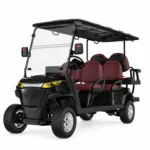
Compare 48V and 72V MXV Golf Carts in Dubai
Tell our team your passenger count, route, daily distance and charging plan. We can help you compare available SUN CART MXV configurations and arrange a Dubai showroom visit.
Is a 72V golf cart always faster than a 48V golf cart?
No. Maximum speed and acceleration depend on the motor, controller, gearing, software settings, tyres, vehicle weight and load. Voltage is only one part of the system.
Does a 72V golf cart always travel farther?
No. Range depends on usable battery energy, system efficiency, passenger load, speed, terrain, temperature and driving style. Compare battery capacity and stated test conditions in addition to voltage.
Is 48V enough for a four-seat golf cart?
It can be, provided the motor, controller, battery and brakes are properly matched to the passenger load and route. Test the exact cart with a realistic load before buying.
Which voltage is better for a hotel or resort?
The answer depends on seating capacity, route, operating hours, slopes and charging opportunities. Hospitality buyers should compare complete 48V and 72V configurations under realistic passenger loads and calculate the full daily duty cycle.
Can I use the same charger for 48V and 72V batteries?
No. Use only a charger designed for the battery pack’s voltage, chemistry and battery management requirements. Confirm compatibility with the vehicle supplier.
Where can I compare SUN CART MXV models in Dubai?
Contact the SUN CART Dubai team to confirm current MXV model availability, specifications, pricing and showroom visit arrangements.

[…] Compare usable battery energy, charger output and the time available between operating shifts. Our 48V vs 72V guide explains why voltage alone is not […]